TEACHING
WS2026/27 / WS2025/26
Fundamentals of Innovation
Assistant Lecturer
Dr. Joaquín Santuber
Kristina Tica MA MA
Mariana Costa Morais MSc
Fundamentals of Innovation
Assistant Lecturer
Dr. Joaquín Santuber
Kristina Tica MA MA
Mariana Costa Morais MSc

Course Description:
This course aims to engage students in a research-based process of investigation into the evolution of disruptive technologies. From the planetary level to networks and social actors, this course will provide students with a vast range of resources, such as film, literature, and media arts, to explore and understand the relation between disruption and technology. In an iterative action-based approach, using design and artistic strategies, students will gain experience in mapping, connecting, and weaving relations between mainstream and obscure histories, developing their critical and analytical thinking.
Furthermore, using design and artistic strategies, students will gain hands-on experience and a comprehensive understanding of concepts of disruptive technologies. Students will learn about systemic approaches for mapping and identifying scopes of technological disruptions that transform societies by looking at their broader networks.
As a result, the students will gain creative agency to envision design interventions, that can enact change and innovation. With a transdisciplinary/participatory approach, this course encourages students to think, actively work and envision orders of technological rise, decline, and disruptions in society.
WS2026/27 / WS2025/26
Fundamentals of Innovation
Assistant Lecturer
Dr. Joaquín Santuber
Kristina Tica MA MA
Mariana Costa Morais MSc
Fundamentals of Innovation
Assistant Lecturer
Dr. Joaquín Santuber
Kristina Tica MA MA
Mariana Costa Morais MSc
Course Description:
This course aims to provide students with a comprehensive understanding of innovation processes and concepts. Working on cases from existing organizations, students will learn about the systemic approaches to mapping and identifying possibilities for transformation by looking at their products, services, and networks. Furthermore, using design and artistic strategies, students will gain hands-on experience in two fundamental modes of transformation and innovation: affirmative and critical approaches, and understand each mode's implications and relevance for the context and goals of the project and organization. This will translate into developing the necessary skills to formulate interventions and strategies for their implementation. As a result, the students will gain creative agency to envision design interventions that can enact change and innovation. With a transdisciplinary/participatory approach, this course encourages students to think, actively work, and envision how other fields can inform transformative and innovative efforts.
This course aims to provide students with a comprehensive understanding of innovation processes and concepts. Working on cases from existing organizations, students will learn about the systemic approaches to mapping and identifying possibilities for transformation by looking at their products, services, and networks. Furthermore, using design and artistic strategies, students will gain hands-on experience in two fundamental modes of transformation and innovation: affirmative and critical approaches, and understand each mode's implications and relevance for the context and goals of the project and organization. This will translate into developing the necessary skills to formulate interventions and strategies for their implementation. As a result, the students will gain creative agency to envision design interventions that can enact change and innovation. With a transdisciplinary/participatory approach, this course encourages students to think, actively work, and envision how other fields can inform transformative and innovative efforts.
SS2025
Winchester School of Arts, University of Southampton
Guest Lecturer /
Guest Workshop /
Artist Talk
Programme:
BSc Creativce Computing
MSc Creative Technologies
12-14/05/25
Topic:
Computational Aesth-ethics: Understanding visual computation processes between the image and it’s context
Winchester School of Arts, University of Southampton
Guest Lecturer /
Guest Workshop /
Artist Talk
Programme:
BSc Creativce Computing
MSc Creative Technologies
12-14/05/25
Topic:
Computational Aesth-ethics: Understanding visual computation processes between the image and it’s context
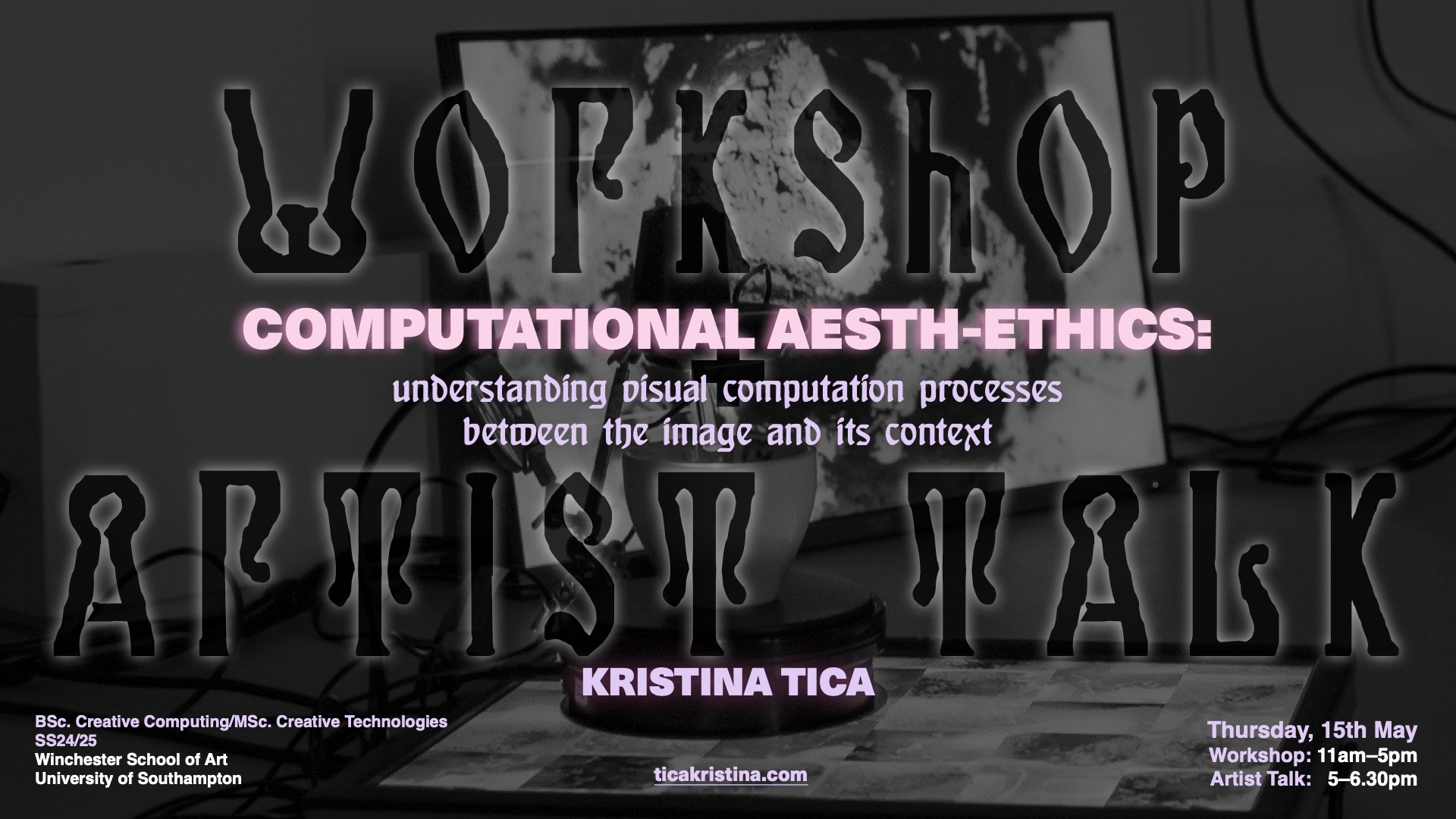
Guest Workshop: The workshop on computational aesth-ethics is established in an intertwined practical and theoretical
framework. The objectives of this workshop are to provide basic understanding of aesthetic and ethical
implications of machine learning-based processes in new media artistic contexts, by exercising with
practical tasks and analysing artistic examples in the field.
During the workshop, we will question what are the new modalities of seeing and experiencing a computational image - from the old new ways of generative image-making to fine-tuned hyper-photo- realistic prompt based models. The workshop will encourage active discussion and thinking exercises on how to extrapolate and find new gaps between human and computer perception and find aesthetic values in them, alongside techno-ethical implications or concerns.
With a set of hands-on experiments and discursive practice and conversations, the students should obtain elementary knowledge in the field of machine learning in visual arts. Therefore they will be able to define and recognise commonly used tools and models in computer vision for (1) image analysis: object detection, face recognition; and (2) image synthesis: styleGAN, text-to-image diffusion models. They will also have the opportunity to assess the algorithmic processes of these models, and to critically discuss their affordances and shortcomings. After attending the workshop, the students should be able to assess, interpret and implement the knowledge in machine learning in visual arts in both practical and conceptual terms to their own projects.
Artist Talk: The talk with Kristina Tica will provide an overview of her artistic and research practice, with insights into processes and pathways that took her practice into a diversity of directions. Her most recent practice centred on the artistic and theoretical exploration of the aesthetics and ethics of machine learning applications in visual computational processes. Tracing the impact of emergent technologies in popular culture under critical theory and philosophy in media and arts, her work activity spans through various disciplines - from visual arts, to coding, writing, and music. The talk will be focused on the processes of critical exploration of emerging technologies over the course of the last six years.

Course Outline: Feminist Hacking Strategies focuses on socio-technical, sustainable,
critical and creative artistic activities. The course is multimodal, and is welcoming hands-on - practical and
theoretical - discursive approach. It brings attention to DYI culture, feminist AI, body/identity hacking,
performativity in practical and theoretic research.
The course aims to focus on divergent approaches in conceptualising, developing and contextualising
participant’s practices, creating a platform for the students to exchange and openly discuss ideas and
concepts, make hands-on prototyping and showcasing their work, and spark curiosity through examples, as
well as tracing academic research, emergent technologies and contemporary media art and culture.
In accordance to the individual/group’s needs it will encourage and support their practices, in artistic or
theoretical research both for students who are encountering this field for the first time, as well as the
students who are fully engaged in some of the feminist hacking practices. Regardless of the previous
knowledge, this course encourages the participants to engage in conversation and exchange providing
different perspectives on the field. It is established as an environment for mutual understanding in which
students are enabled to express and develop their concepts, artistic identities and introspective,
(self-)reflective approach in their practices.
FURTHER LINKS
+ ACM Directory
+ LEONARDO NETWORK DIRECTORY
+ Leonardo Graduate Abstracts Service 2023
+ ORCiD
+ Research Gate
CV
CONTACT